West China Hospital's Bone Banking Innovation Transforms Hip Revision Surgery
"Save It Now, Use It Later" — A New Era in Joint Reconstruction
What if the bone removed during one surgery could be frozen, stored, and used years later to save the same patient from a far more difficult procedure?
That's exactly what happened at West China Hospital (Sichuan University), where the orthopedic team has pioneered an autologous bone tissue banking system — storing a patient's own healthy bone at -196°C in liquid nitrogen, preserving its biological activity and structural integrity for future use.
The concept sounds simple. The execution required years of research and a level of surgical planning that few hospitals in the world can deliver.
17 Years of Hip Problems
The patient, a 68-year-old man, had been battling hip disease for nearly two decades:
| Year | Procedure |
|---|---|
| 2009 | Bilateral femoral head decompression (drilling) for avascular necrosis |
| 2012 | Right total hip replacement |
| 2019 | Right hip revision surgery (first revision) |
| 2026 | Right hip prosthesis loosening again + left hip femoral head necrosis |
By 2026, he was facing a nightmare scenario: his right hip prosthesis had loosened again with significant bone loss around the socket (acetabular osteolysis), and his left hip had also deteriorated to the point of needing a total replacement.
Revision hip surgery with severe bone loss is one of the most challenging procedures in orthopedics. The surgeon needs bone graft material to rebuild the socket before a new implant can be anchored — but where does that bone come from?
The Traditional Problem
Conventionally, surgeons have three options for bone graft in revision surgery — none of them ideal:
| Source | Drawback |
|---|---|
| Allograft (donor bone from a bone bank) | Risk of immune rejection; limited availability; disease transmission risk |
| Autograft (harvested from the patient's own pelvis) | Requires a second surgical site, causing additional pain, bleeding, and recovery time |
| Synthetic bone substitute | Lacks natural biological activity; slower integration |
The West China Solution
Dr. Kang Pengde and Dr. Zhou Zongke, leading orthopedic surgeons at West China Hospital, devised a two-stage approach using the hospital's autologous bone tissue banking system:
Stage 1 — January 14, 2026: Left Hip Replacement + Bone Harvest
During the left total hip replacement, the surgical team removed the damaged femoral head — bone that would normally be discarded as surgical waste. Instead, they:
- Processed the bone under strict sterile protocols
- Placed it into a -196°C vapor-phase liquid nitrogen storage system
- Preserved its natural biological activity and structural integrity
The patient recovered from his left hip surgery as normal. Meanwhile, his own bone tissue waited in deep freeze.
Stage 2 — March 2026: Right Hip Revision + Bone Reconstruction
Two months later, the team tackled the much harder procedure: revising the failed right hip. Using 3D-printed acetabular models for pre-surgical planning, they:
- Removed the loosened prosthesis and damaged tissue
- Retrieved the patient's own stored bone from the tissue bank
- Used it to rebuild the eroded acetabular socket — filling the bone defects
- Implanted a new revision prosthesis into the reconstructed socket
No additional bone graft material was needed. No second harvest site. No donor bone. No rejection risk.
The Outcome
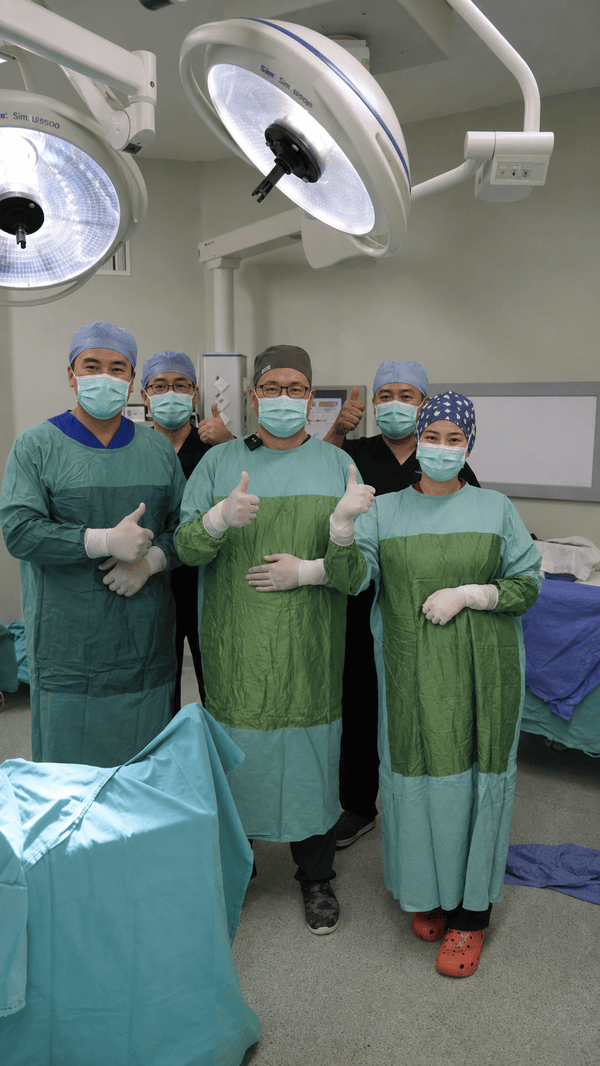
The patient's recovery has been excellent:
- Wound healing: Normal, no complications
- Right hip function: Restored
- Current mobility: Walking with partial weight-bearing using crutches
- Rehabilitation: Ongoing, progressing well
- Immune rejection: None — it was his own bone
Why This Matters for International Patients
Joint revision surgery — especially with significant bone loss — is a procedure where hospital experience and innovation directly determine outcomes. West China Hospital's autologous bone banking approach offers three critical advantages:
- Zero rejection risk — The graft material is the patient's own tissue
- No additional surgical trauma — No need to harvest bone from the pelvis or other sites
- Superior biological integration — Natural bone retains growth factors and structural properties that synthetic materials cannot replicate
For international patients facing complex revision surgery, this technique can mean the difference between a successful reconstruction and a compromised result.
Hip Revision Surgery Cost: China vs Western Countries
| Procedure | China (West China Hospital) | United States | United Kingdom (Private) |
|---|---|---|---|
| Primary total hip replacement | $8,000 - $14,000 | $32,000 - $50,000 | $15,000 - $25,000 |
| Hip revision (simple) | $12,000 - $20,000 | $50,000 - $80,000 | $25,000 - $40,000 |
| Hip revision with bone graft reconstruction | $15,000 - $28,000 | $70,000 - $120,000 | $35,000 - $60,000 |
| Autologous bone banking + staged revision | $18,000 - $32,000 | $90,000 - $150,000 | $45,000 - $75,000 |
China prices include surgery, implant, hospital stay, bone processing/storage, and post-operative rehabilitation.
About West China Hospital
West China Hospital is consistently ranked among China's top 3 hospitals and is one of the largest single-site hospitals in the world:
- 4,300+ beds with comprehensive orthopedic subspecialties
- Orthopedics department ranked #2 nationally, performing thousands of joint replacements annually
- Research leader — affiliated with Sichuan University, pioneering bone tissue engineering
- Located in Chengdu, with direct international flights from many global cities
Facing a complex hip or knee revision? Get a free surgical consultation →