Robotic Precision: Xi'an Jiaotong University Hospital Uses Surgical Robot for Femoral Neck Fracture Repair
When a Robot Guides Every Screw to Sub-Millimeter Accuracy
Femoral neck fractures are among the most consequential injuries in orthopedics. A poorly placed screw can lead to femoral head necrosis, non-union, and permanent disability. A precisely placed screw can preserve the hip joint and restore full mobility.
The difference often comes down to fractions of a millimeter — a margin too fine for the human eye alone.
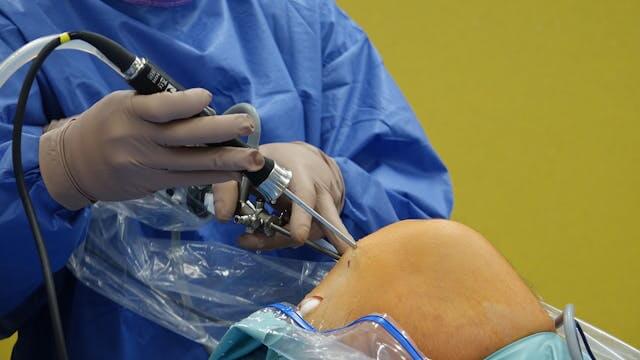
At the Lugang Campus of Xi'an Jiaotong University First Affiliated Hospital (XJTU-FAH), the orthopedic team led by Deputy Director Du Heng has now brought robotic surgical navigation into trauma orthopedics, successfully performing a robot-assisted cannulated screw fixation for a 50-year-old male patient with a femoral neck fracture.

The Clinical Challenge
Femoral neck fractures occupy a unique position in orthopedic surgery — they are common, but the consequences of suboptimal treatment are severe:
| Complication | Cause | Consequence |
|---|---|---|
| Femoral head avascular necrosis | Screw placement disrupts blood supply | Hip joint collapse; eventual total hip replacement needed |
| Non-union | Inadequate compression or unstable fixation | Chronic pain; inability to walk; reoperation required |
| Screw cut-out | Screws placed too close to cortex or in weak bone | Fixation failure; emergency revision surgery |
Traditional surgery relies on intraoperative fluoroscopy (X-ray) to guide screw placement. The surgeon repeatedly repositions the C-arm, takes images, adjusts angles — a process that is time-consuming, exposes both patient and surgeon to radiation, and still depends heavily on the surgeon's spatial judgment.
How the Robot Changes the Equation
The robotic navigation system deployed at XJTU-FAH Lugang Campus fundamentally transforms the surgical workflow:
Step 1 — 3D Planning
Using the patient's pre-operative CT data, the surgical team plans the exact trajectory, depth, and angle of each cannulated screw in a three-dimensional virtual model of the patient's femur.
Step 2 — Intraoperative Registration
The robotic system registers the patient's real anatomy to the virtual plan, creating a live correspondence between the digital model and the physical bone.
Step 3 — Robotic Guidance
The robotic arm positions a guide sleeve along the pre-planned trajectory with sub-millimeter accuracy. The surgeon drills and places screws through this guide — the robot ensures the path never deviates from the plan.
Step 4 — Real-Time Verification
The system provides visual pressure feedback monitoring insertion resistance in real time, alerting the surgeon if the screw approaches cortical bone or articular cartilage — preventing the most feared complication: screw penetration into the hip joint.
Robot-Assisted vs. Traditional Screw Fixation
| Factor | Traditional (Freehand + Fluoroscopy) | Robot-Assisted (XJTU-FAH) |
|---|---|---|
| Screw placement accuracy | Surgeon-dependent; mm-level variance | Sub-millimeter precision |
| Radiation exposure | High (repeated fluoroscopy shots) | Significantly reduced |
| Need for external guides | Bone-mounted jigs sometimes needed (additional trauma) | No additional hardware on bone |
| Screw distribution | Variable; depends on surgeon experience | Optimally distributed per 3D plan |
| Risk of cartilage penetration | Detected only on post-op imaging | Prevented in real time by pressure feedback |
| Operative time | Variable | Comparable or shorter |
The Outcome
The 50-year-old patient's surgery was completed successfully with all screws placed precisely according to the pre-operative plan. Post-operative imaging confirmed optimal screw positioning with even distribution — laying the foundation for fracture healing while preserving the blood supply critical to preventing femoral head necrosis.
From Spine to Trauma: A Growing Robotic Platform
This case represents an important expansion for XJTU-FAH's robotic orthopedic program. Since performing their first robot-assisted spinal surgery in September 2025, the Lugang campus orthopedic team has now extended the platform to trauma surgery — achieving coverage across two major orthopedic subspecialties.
The team noted this milestone represents a "technical extension and innovative breakthrough in digital smart orthopedics", establishing a foundation for applying robotic navigation to an even broader range of musculoskeletal procedures.

Orthopedic Fracture Surgery Cost: China vs Western Countries
| Procedure | China (XJTU-FAH) | United States |
|---|---|---|
| Femoral neck screw fixation (traditional) | $4,000 - $8,000 | $25,000 - $50,000 |
| Robot-assisted screw fixation | $6,000 - $12,000 | $35,000 - $70,000 |
| Total hip replacement (if fixation fails) | $8,000 - $14,000 | $32,000 - $50,000 |
| Robot-assisted spinal fusion (per level) | $10,000 - $18,000 | $50,000 - $100,000 |
China prices include surgery, implants, robotic system usage, hospital stay, and post-operative imaging.
Who Should Consider Robotic Orthopedic Surgery?
Robotic navigation is particularly valuable for patients with:
- Femoral neck fractures — Where screw accuracy directly determines whether the hip joint survives
- Osteoporotic bone — Where screw purchase is critical and margin for error is minimal
- Complex spinal conditions — Where pedicle screw misplacement risks nerve damage
- Revision surgery — Where distorted anatomy from previous operations makes freehand placement unreliable
- Young patients — Where joint preservation is the priority and every millimeter of accuracy matters for long-term outcomes
About XJTU First Affiliated Hospital
Xi'an Jiaotong University First Affiliated Hospital is one of Northwest China's premier medical centers:
- Affiliated with Xi'an Jiaotong University — a top-15 Chinese university and C9 League member
- Orthopedic department with comprehensive subspecialty coverage: spine, trauma, joint reconstruction, and sports medicine
- The Lugang Campus serves as a modern extension equipped with the latest surgical technology
- Located in Xi'an — SinomedTrip's home city, enabling seamless coordination for international patients
Facing a fracture or orthopedic condition that demands precision? Explore orthopedic treatment options in China →
Need advanced orthopedic care with robotic precision? Request a free surgical consultation →