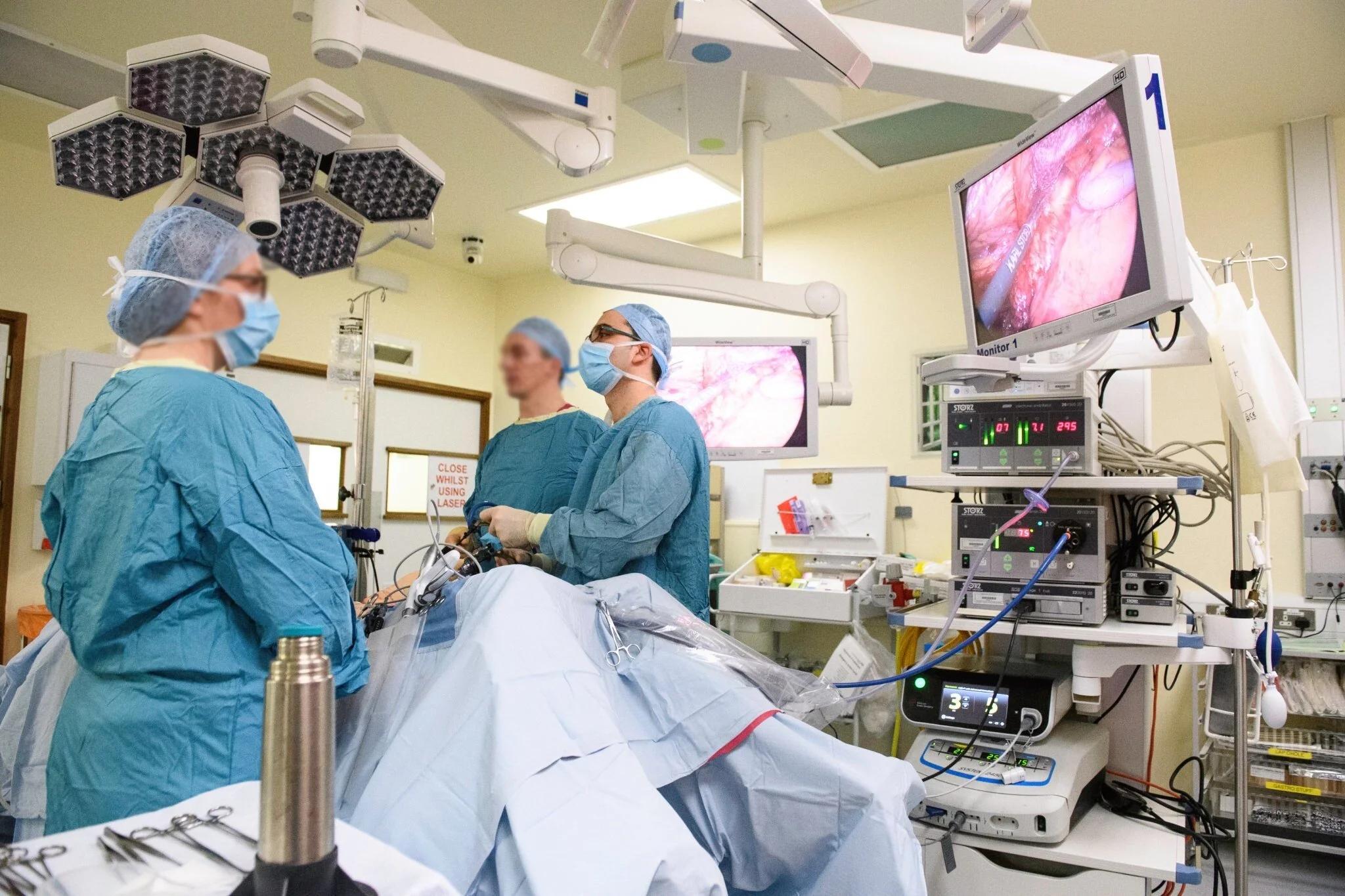
PUMCH's 2-Minute Eye Surgery Technique Replaces Complex Vitrectomy Revisions
A 2-Minute Procedure That Changes Everything for Post-Surgical Eye Bleeding
When bleeding recurs inside the eye after vitrectomy — one of the most common retinal surgeries — patients traditionally face a difficult choice: wait and hope the blood clears on its own, or undergo another full surgical procedure under general anesthesia with all its associated risks.
Surgeons at Peking Union Medical College Hospital (PUMCH) have developed a third option: a 2-minute, office-based technique that clears the bleeding through a bent needle — no operating room, no general anesthesia, no overnight stay.
The technique, first published in the international journal RETINA in August 2025, has now been successfully deployed beyond Beijing, with PUMCH surgeons performing the first case in Guizhou province on an 11-year-old patient.

The Problem: Recurrent Bleeding After Vitrectomy
Vitrectomy is a common eye surgery used to treat conditions like retinal detachment, diabetic retinopathy, and macular holes. During the procedure, the vitreous gel inside the eye is removed and replaced with saline or gas.
A known complication is recurrent vitreous hemorrhage — bleeding that occurs days or weeks after the initial surgery. When this happens, the patient's vision becomes cloudy or completely obscured.
Traditional solutions have significant drawbacks:
| Approach | Procedure | Drawbacks |
|---|---|---|
| Wait and observe | No intervention; hope blood reabsorbs | Can take weeks to months; risk of complications from prolonged blood contact |
| Repeat vitrectomy | Full surgical procedure under general anesthesia | Invasive; risk of iatrogenic damage; expensive; requires OR time |
| Conventional lavage | Straight-needle irrigation | Risk of retinal damage from rigid needle trajectory |
The PUMCH Innovation: Bent-Needle Vitreous Lavage
The PUMCH ophthalmology team developed a technique using a 25-gauge bent needle paired with a 30-gauge irrigation needle on the opposite side of the eye. The bend in the needle allows the surgeon to navigate the interior of the eye safely, avoiding contact with the retina.
How it works — step by step:
- Local anesthesia — Topical or peribulbar block; the patient is awake and comfortable
- Insertion — The 30G irrigation needle enters one side to maintain eye pressure; the 25G bent needle enters the opposite side
- Lavage — Gentle irrigation flushes the blood-stained fluid out through the bent needle while fresh balanced salt solution flows in
- Completion — Both needles are removed; the self-sealing puncture sites require no sutures
Total procedure time: 1-2 minutes.
Key Advantages Over Traditional Approaches
| Factor | Bent-Needle Lavage (PUMCH) | Repeat Vitrectomy |
|---|---|---|
| Anesthesia | Local only | General or regional |
| Duration | 1-2 minutes | 30-60 minutes |
| Setting | Clinic/office | Operating room |
| Iatrogenic damage risk | Minimal (bent needle avoids retina) | Higher |
| Recovery | Next-day discharge | 3-7 day recovery |
| Post-op positioning | None required | Often face-down for days |
| Effect on fundus exam | No interference | May obscure view temporarily |
| Cost | Fraction of full surgery | Full surgical fees |
The Patient: An 11-Year-Old Boy
The case that brought this technique to Guizhou province involved Xiao Huang, an 11-year-old boy who had previously undergone vitrectomy on his left eye. During follow-up, his doctors discovered that bleeding had recurred inside the eye, obscuring his vision.
On April 24, he was seen at Guizhou Provincial People's Hospital, where Dr. Wu Chan — a PUMCH ophthalmologist stationed at the hospital as part of a national medical aid program — evaluated him.
Three days later, on April 27, Dr. Wu performed the bent-needle vitreous lavage. The procedure went smoothly. By the next morning, Xiao Huang's eye had recovered well, and he was discharged the same day.
This was the first time this technique had ever been performed in Guizhou province.
Why This Technique Matters for International Patients
For patients traveling to China for eye treatment, this innovation offers practical advantages:
- Shorter hospital stay — A procedure that once required days of recovery now takes minutes with next-day discharge
- Lower risk profile — Avoiding general anesthesia is especially important for pediatric patients, elderly patients, and those with complex medical histories
- Cost savings — Eliminating the need for an operating room, anesthesia team, and extended hospital stay dramatically reduces the total cost
- Combinable with other treatments — Patients traveling for retinal surgery can have this as a backup plan if post-surgical bleeding occurs, without extending their trip significantly
Considering eye surgery in China? This technique is one example of how China's top hospitals are developing innovations that reduce patient burden while maintaining world-class outcomes.

Eye Surgery Cost: China vs Western Countries
| Procedure | China (PUMCH) | United States | United Kingdom (Private) |
|---|---|---|---|
| Vitrectomy | $3,000 - $6,000 | $15,000 - $30,000 | $8,000 - $15,000 |
| Vitreous lavage (bent-needle) | $500 - $1,200 | Not widely available | Not widely available |
| Repeat vitrectomy for hemorrhage | $2,500 - $5,000 | $12,000 - $25,000 | $7,000 - $12,000 |
| Retinal detachment repair | $3,500 - $7,000 | $15,000 - $35,000 | $10,000 - $18,000 |
China prices include procedure, medications, and follow-up consultation.
About PUMCH Ophthalmology
The PUMCH ophthalmology department, led by Dr. Yu Weihong, is one of China's most respected eye care programs:
- Affiliated with Peking Union Medical College — China's most prestigious medical school
- Published this technique in RETINA — one of the world's top ophthalmology journals
- Active in national medical aid programs, bringing advanced techniques to underserved regions
- Located in central Beijing, with established international patient services
Frequently Asked Questions
Is the bent-needle technique available for international patients?
Yes. PUMCH's ophthalmology department accepts international referrals. The technique can be performed as a standalone procedure or as part of a broader retinal treatment plan.
Does it work for all types of vitreous hemorrhage?
It is most effective for post-vitrectomy recurrent hemorrhage. For hemorrhage caused by other conditions (e.g., proliferative diabetic retinopathy with active neovascularization), a full vitrectomy may still be necessary.
How soon can I fly after the procedure?
Since no gas or oil tamponade is used, there are no flying restrictions after bent-needle lavage — unlike after standard vitrectomy where patients may need to wait 2-8 weeks before air travel.
Is it safe for children?
Yes. The 11-year-old patient in Guizhou recovered fully with next-day discharge. The local anesthesia approach avoids the risks of general anesthesia in pediatric patients.
Need specialized eye care in China? Request a free ophthalmology consultation →